Listing
If a building boasts special architectural and/or historic interest it can be ‘listed’, affording it statutory protection from any alteration, redevelopment, or demolition which might affect this interest. Listing was introduced in Northern Ireland in 1974, and currently the Historic Environment Division of the Department for Communities is responsible for compiling and amending this list under Section 80 of the Planning Act (NI) 2011:
This list is amended and compiled under the advice of the Historic Buildings Council (HBC), a statutory advisory council, which reports to the Department on matters relating to architecture, architectural history, planning, industrial heritage, and building conservation in Northern Ireland.
Protection
It is an offence under Section 85 of the Planning Act to demolish, materially alter, or extend a listed building in any manner that would affect its character without first obtaining Listed Building Consent (LBC). Failure to obtain LBC or comply with the conditions of LBC could result in fines of up to £100,000 and/or a prison sentence of up to two years. When applying for LBC, a full planning application must also be submitted. It is important to note, however, that listed places of worship are exempt from the requirement to obtain Listed Building consent for demolition, alteration, or extension as long as the building is used for ecclesiastical purposes or would be so used but for the works. This is known as ecclesiastical exemption.
It is important to remember that both the interior and exterior of a listed building are protected. Furthermore, protection is afforded to structures within the building’s curtilage (the land immediately surrounding it forming one enclosure).
As of 2023, there are around 8900 listed buildings in Northern Ireland; all of these can be seen or searched for on the Northern Ireland Buildings Database, maintained by the Department for Communities. Additionally, the database contains a record of unlisted buildings which have been surveyed and deemed architecturally or historically significant but not to the extent that would pass the statutory test.
The Database usually includes a description for each listed building alongside its historic building reference number (HB XX/XX/XXX). A listed building description discloses the criteria the building met to warrant listing, followed by a wealth of supporting information, including:
The Buildings Database can be accessed here.
The information available on the Buildings Database can also be viewed on the Historic Environment Map Viewer here.
Conservation Areas
Often, listing buildings in isolation is not enough to maintain the character and appearance of a particular place. In light of this, places of special architectural and/or historic interest can be designated as ‘Conservation Areas’ by District Councils, acting on the advice of the Historic Buildings Council. Conservation Areas allow the social, cultural, and aesthetic history of certain places to be protected from indiscriminate or ill-considered change, as in these areas it is desirable to preserve and enhance the character of the built heritage, its surroundings, and the general environment, as a whole. Northern Ireland’s Conservation Areas are protected under Section 104 of the Planning Act (NI) 2011.
A selection of Northern Ireland’s Conservation Areas include:
Councils have a duty to carry out Conservation Area Appraisals in which the significance of the character area is reviewed. In some cases, Conservation Area boundaries can be extended or retracted if new information comes to light.
A full list of Conservation Areas can be found here.
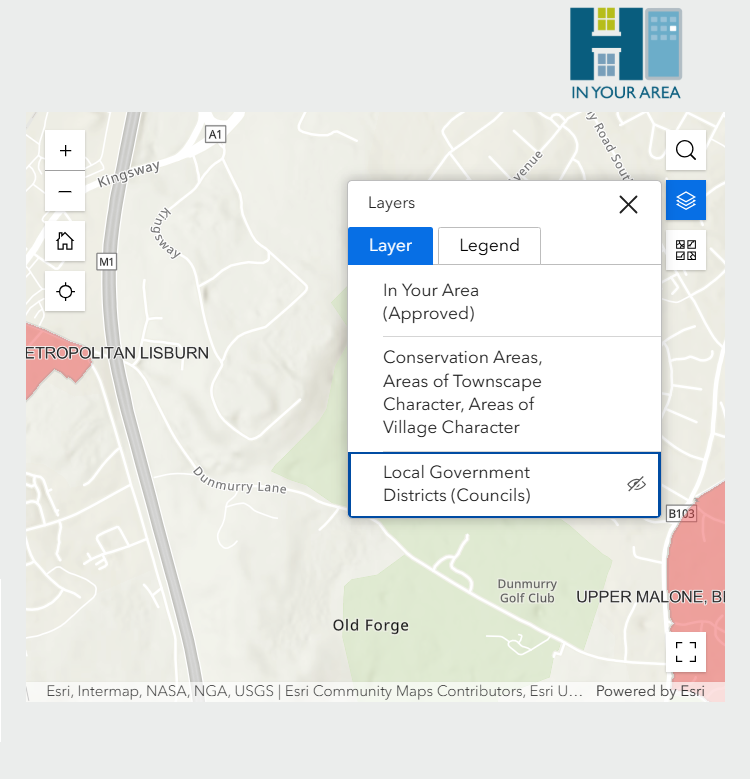
See also our planning objection toolkit below, which lists Conservation Areas by council, and see the In Your Area map which allows you to view conservation areas on the map.
Click the ‘layers’ icon to turn on the overlay of Conservation Areas and other protections (see ATVs and ATCs below). You can also turn on the overlay of Local Government Districts (Councils) to establish which council the area you are interest in is within.
Protection
Incremental chadnges, no matter how minimal, can have a devastating impact on the special architectural and/or historic interest of a character area. It is for this reason that works on unlisted buildings, along with the felling, lopping, topping, or uprooting of trees in a Conservation Area require Conservation Area Consent.
Area of Townscape or Village Character (ATC or AVC)
Certain areas in Northern Ireland’s cities, towns, and villages may have a distinctive character without being of sufficient architectural or historic interest to warrant Conservation Area status. However, because of their own unique identity, they can be designated as Areas of Townscape or Village Character (ATCs or AVCs).
Works to or demolition of unlisted buildings within ATCs or AVCs do not require specific consent. However, they are a material consideration in planning applications. Futhermore, District Councils, in the production of their Local Development Plans, take into consideration the intrinsic and special character of these areas so as to preserve their identity and integrity.